Showing posts with label SARAWAK ETHNICS. Show all posts

Thursday, 10 May 2012

THE NOMADIC PENAN.....GUARDIAN OF THE FOREST


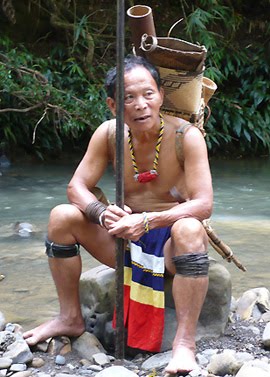
The Penan are a nomadic aboriginal people living in Sarawak and Brunei. They are one of the last such peoples remaining. The Penan are noted for their practice of 'molong' which means never taking more than necessary. Most Penan were nomadic hunter-gatherers until the post-World War II missionaries settled many of the Penan, mainly in the Ulu-Baram district but also in the Limbang district. They eat plants, which are also used as medicines, and animals and use the hides, skin, fur, and other parts for clothing and shelter.

The Penan number around 10,000; only 200 are nomadic. The Penan can be broken down into two loosely related geographical groups known as either Eastern Penan or Western Penan, the Eastern Penan residing around the Miri, Baram, Limbang and Tutoh regions and the Western Penan in and around Belaga district.

They can be considered as a native group or 'tribe' in their own right, with a language distinct from other neighbouring native groups such as the Kenyah, Kayan, Murut or Kelabit. However, in government censuses they are more broadly classified as Orang Ulu which translates as 'Upriver People' and which contains distinct neighbouring groups such as those above. Even more broadly they are included in the term 'Dayak', which includes all of Sarawak's indigenous people.

Lifestyle

Penan communities were predominantly nomadic up until the 1950s. The period from 1950-present has seen consistent programmes by the state government and foreign Christian missionaries to settle Penan into longhouse-based villages similar to those of Sarawak's other indigenous groups.[4] Some, typically the younger generations, now cultivate rice and garden vegetables but many rely on their diets of sago (starch from the sago palm), jungle fruits and their prey which usually include wild boar, barking deer, mouse deer but also snakes (especially the Reticulated Python or kermanen), monkeys, birds, frogs, monitor lizards, snails and even insects such as locusts.


Since they practice 'molong', they pose little strain on the forest: they rely on it and it supplies them with all they need. They are outstanding hunters and catch their prey using a 'lepud' or blowpipe, made from the Bilian Tree (superb timber) and carved out with unbelievable accuracy using a bone drill - the wood is not split, as it is elsewhere, so the bore has to be precise almost to the millimetre, even over a distance of 3 metres. The darts are made from the sago palm and tipped with poisonous latex of a tree found in the forest which can kill a human in a matter of minutes. Everything that is caught is shared as the Penan have a highly tolerant, generous and egalitarian society, so much so that it is said that the nomadic Penan have no word for 'thank you' because help is assumed and therefore doesn't require a 'thank you'. However, 'jian kinin' is typically used in the settled communities. Very few Penan live in Brunei any more, and their way of life is changing due to pressures that encourage them to live in permanent settlements and adopt year-around farming.




Penan resistance to deforestation in Sarawak

The Penan came to national and international attention when they resisted logging operations in their home territories of the Baram, Limbang, Tutoh and Lawas regions of Sarawak. Since both the settled, semi-nomadic and nomadic Penan communities were and are reliant on forest produce, they were hit hard by the large scale logging operations that encroached on their traditionally inhabited territories.

The logging caused the pollution of their water catchment areas with sediment displacement, the loss of many sago palms that form the staple carbohydrate of Penan diet, scarcity of wild boar, deer and other game, scarcity of fruit trees and plants used for traditional forest medicine, destruction of their burial sites and loss of rattan and other forest products.

 Penan blockade

 Penan blockade

Beginning in the late 1980s and continuing today the Penan and other indigenous communities such as the Iban, Kelabit and Kayan (collectively referred to as Dayak) have set up blockades in an attempt to halt logging operations on their land. These succeeded in many areas but the efforts were hard to sustain and ended in large scale clashes between the indigenous communities and the state backed logging companies, supported by the police and Malaysian army.

The confrontations ended with several deaths, many injuries and large scale arrests of indigenous people. Many of the detained reported being beaten and humiliated while in custody. An independent Sarawakian organisation IDEAL documented such claims in a 2001 fact finding mission entitled "Not Development, but Theft".

The Penan explicitly outlined their wants and requirements to the Sarawak State Government of Abdul Taib Mahmud in the 2002 Long Sayan Declaration. The confrontation between the Penan and Sarawak State Government has continued to the present day.

Most recently the blockade setup by the Penan community of Long Benali was forcefully dismantled on 4 April 2007 by the Sarawak Forestry Corporation (SFC), with support from a special police force unit and overlooked by Samling Corporation employees. Samling Corporation had been granted a logging concession by the Malaysian Timber Certificate Council (MTCC) that included land traditionally inhabited by the Penan of Long Benali and despite their continued petitions against the concession.

Bruno Manser


Bruno Manser was an environmental activist and champion of the Penan's plight during their struggle in the 1990s. Named lakei Penan (Penan man) by the Penan, he helped communicate the Penan's cause to the outside world, firstly writing letters to Chief Minister Abdul Taib Mahmud and later leaving Sarawak to educate the outside world (especially timber importing countries in Europe and Japan) about the deforestation and related social problems in Sarawak. He later conducted public awareness stunts such as paragliding onto the lawn of Chief Minister Abdul Taib Mahmud and attempting a hunger strike outside the offices of Japanese shipping companies in Tokyo.


In 2000, Manser went missing when he secretly returned to Sarawak to reunite with a Penan group, his body and belongings have never been found despite intensive searches. Theories of assassination by the Sarawak government or logging companies have sprung up (due to a reputed US$40,000 bounty on his head). Other rumors include those of suicide after years of unsuccessful campaigning or getting lost in the dense mossy forests around Bukit Batu Lawi in the Kelabit Highlands, close to the border with Kalimantan. However, Manser had lived for several years in the region with the nomadic Penan and was thus highly experienced.

The future of the Penan


The future of the Penan has been a controversial subject since the confrontation between indigenous rights and state land use began. National and International Non-Governmental Organisations have been pressing for indigenous self-determination and respect for Penan human and land rights in accordance with UN International Labour Organisation Convention N. 169 (1989) that removes “assimilationist” orientated international standards towards indigenous rights, a convention that Malaysia has not adopted.

However, many Malaysian politicians have criticised NGOs for meddling in Malaysian domestic affairs and have accused them of attempting to inhibit development projects and keep the Penan 'undeveloped' and unassimilated into mainstream Malaysian society. Most see the Penan's lifestyle as uncivilised and antiquated (compare White man's burden), an example of this is a regularly recited poem by ex Minister for Environment and Tourism Datuk James Wong

"O Penan - Jungle wanderers of the Tree
What would the future hold for thee?....
Perhaps to us you may appear deprived and poor
But can Civilization offer anything better?....
And yet could Society in good conscience
View your plight with detached indifference
Especially now we are an independent Nation
Yet not lift a helping hand to our fellow brethren?
Instead allow him to subsist in Blowpipes and clothed in Chawats [loincloths]
An anthropological curiosity of Nature and Art?
Alas, ultimately your fate is your own decision
Remain as you are - or cross the Rubicon!"

Many Malaysian organisations have joined the debate such as Sahabat Alam Malaysia (SAM), Borneo Resource Institute (BRIMAS) and Rengah Sarawak. These grassroots organisations have supported indigenous rights and accused the Sarawak state government of repeated neglect of Sarwak's indigenous citizens and exploitation of Sarawak's natural resources. The opposition party Parti Keadilan Rakyat has also taken up the cause of the indigenous people's plight, claiming that they are "living lives of quiet desperation that now and then flares up in action that invites police attention, not to mention the notice of the rest of Malaysians who don't quite know what it is to be under the tyranny of geography."

With the help of such NGOs many Penan communities have mapped their proposed ancestral lands and filed claims in Sarawak's courts in the hope of preventing and deterring illegal logging of their forests. An important precedent was set in 2001 when an Iban village of Rumah Nor won a landmark court victory against Borneo Pulp and Paper and the Sarawak Government for violating their Native Customary Right (NCR) or adat. The victory was recently publicised in a short documentary - Rumah Nor - by the Borneo Project. The verdict is being threatened by a Federal Court appeal by the State Government and Borneo Pulp and Paper. However, 19 Penan communities have now mapped their NCR and four are beginning litigation and in others the logging has more or less stopped in the territory where litigation is pending. Indigenous action has therefore shifted from the human blockades of logging roads to empowerment through the political and legal system and international publicity.


Penan language

The Penan language belongs to the Malayo-Polynesian branch of the Austronesian language family. It forms an own Group within the Borneo branch of the Borneo-Philippines languages. It may be somewhat related to the Kenyah Languages and might show some evidence of a non Austronesian substrat that might be related to Orang Asli type of language.[15] The Penan language is linguistically interesting since it has six words for varying levels of "we" depending on how extensive the described group in the society is at the same time as having no word to say "thank you" or describe the status of a domestic animal. This provides a good example in discussion of the subject-object problem in philosophy and its relation to language and power.


Relevant entry :

->  THE PUNAN


THE KELABIT.....inhabitants of a remote plateau in the Sarawak Highlands


The Kelabits of Sarawak First "discovered" around the turn of the 20th Century, the Kelabits, a tribe of fierce warriors and headhunters who saw off anyone entering their territory, were generally given a wide berth by neighbouring tribes. Their origins are not known. Culturally and linguistically, they are distinct in many ways from the other thirty or so tribes in Sarawak.Under broad conical hats, they wore their hair long at the back or done up in a bun held in place by pins of metal or horn. Around the waist hung a long sword-parang with a curved staghorn hilt and wooden scabbard. The men had two holes on each ear, pierced during infancy. The bottom hole was adorned with heavy brass ear rings which greatly extended the ear lobes so that they often hung down to the shoulders. In the upper hole, kept open by wooden plugs, the warriors wore leopard's fangs.

the Kelabits, a tribe of fierce warriors and headhunters who saw off anyone entering their territory

The women had elaborate tattoos, a fine lacework of dots and lines, on almost the entire lower limb, from the foot to well up the thigh, so finely decorated that from a distance, it looked as though they were wearing blue-black stockings. They also wore brightly coloured skull caps, and their eyebrows were plucked for the sake of beauty.


a kelabit girl

Their homeland, now called the Kelabit Highlands, is pretty much a large plateau ringed by a series of jungle-covered mountain peaks.Lying at an altitude of between 3400 to 6000 feet above sea level in the north-eastern corner of Sarawak, their territory extends to the Sarawak edge of a central mountain spur that divides Borneo along the middle. On the other side of this spur lies the Indonesian state of Kalimantan, formerly part of Dutch Borneo.One of the smallest tribes in Sarawak and, now, a branch of the Orang Ulu, the total Kelabit population of about 6000 people represents a mere 0.4% of Sarawak's population of 1.5 million, just 0.027% of Malaysia's 22 million. Less than a third of them live in the highlands. The rest have moved away to the towns, for further education, to find jobs, and so on.


Short History of Bario

In the tribal heartlands, most Kelabits live in longhouses. Bario Asal, the original longhouse (until 1963, the only longhouse) at what is now called Bario, extends in territory from the Tama Abu range to the Dabpur River. The plains it is located upon, and the longhouse itself, was known to the Kelabits as Lemba'a (literally wet place). Members of Z Special Force made a parachute drop into this area in 1945 and set up their HQ there. Defining this operational area as "The Plains of Bah", they waged a guerrilla campaign against Japanese forces with the help of Kelabit warriors.

When the war was over, the Kelabits finally entered the mainstream of 20th Century life. In recognition of wartime service, many warriors from this longhouse were awarded medals and decorations. And the airstrip built to service the war effort became, and still remains, the only gateway into Kelabit territory.

Shortly after the war, groups of missionaries arrived, chastised the Kelabits roundly for their pagan ways of life, destroyed many cultural artifacts and converted them into Christianity, almost en masse! Around that time, too, came the first schools. Sarawak was then a British Colony. In 1963, Sarawak joined Malaya as another state in the newly-formed Federation of Malaysia. Indonesia laid territorial claims to Sarawak and began what is now known as the Confrontation, with Indonesian soldiers entering Sarawak and attacking tribal people living along the border areas.Since Bario had the largest area of flat land on which to build an airstrip, it became the operational centre for British forces stationed to defend other Kelabit longhouses deep in the interior.

However, many of these were too close to the Indonesian border and too dispersed to be properly defended. People from the border areas were, thus, re-settled on the Bario plains, to protect them from Indonesian attack. Land was donated to them by the people of Lemba'a, not only for building new longhouses but also for raising padi.

These migrations, staggered over a period of time, were quite complex. The original longhouse people renamed their home Bario Asal to differentiate it from those of the newcomers.

Upper and Pa' Ramapuh Lower - these two longhouses, side by side astride a small stream to the front of the Junior School, were built by people from now-extinct longhouses at Pa' Main and the original Pa' Umor.

The following longhouses are currently also located on the Bario plains:

Arur Dalan - located beyond Bario Asal at the foothills of the Tama Abu range, its people originating from the now extinct Kuba'an and Pa' Tik longhouses. (Note: The latter has been revived by nomadic Penans in comparatively recent times.)

Pa' Umor - located on the east bank of the Dabpur River, inhabited by Kelabits from a longhouse of the same name once located on the hills adjoining Kalimantan. Arur Layun - a small seven-door longhouse, lying across the road from Bario Asal just behind the church, built by people moving in from Pa' Bangar and Pa' Lungan.

Pa' Ramapuh Ulung Palang Upper, its people originating mostly from the now extinct Pa' Main longhouse, and Ulung Palang Lower, with people from the now extinct Pa' Mada longhouse near Long Dano - lie between the old airstrip and the two schools. (Note: The former was destroyed by fire on 8th August 1997 and has not been re-built.)

Pa' Derung - about an hour away on foot from Bario proper, now home to people who came from Kuba'an and, in more recent time, from Long Lellang. Several new longhouses have come up since the upheavals of 1963 and 1964:Pasir Puteh - once listed as two separate entities, namely, Padang Pasir (around the old runway) and Kampung Baru (about half an hour away from the runway). Not really a longhouse, except as an administrative entity, it is an assortment of single houses built around the old airstrip and several government buildings. The area was developed fairly recently, around and after 1990, mostly by displaced retired Border Scouts from various places, such as Pa' Ramudu, Pa' Dalih and Long Dano.

Kelabit Girl at Ba'kalalan


Bario's one and only shopping mall is located there! Pa' Ukat - around an hour away from Bario, and built around 1970 by people moving in from Pa' Umor and Pa' Lungan. Farther afield from Bario lie several old Kelabit longhouses, ranging from six to ten hours away from Bario, these being the travelling times on foot through the jungle: Pa' Lungan - around three hours away.

Long Dano - around nine hours away, at about 3000 feet above sea level. Pa' Dalih - around ten hours away, near Long Dano, at about 3000 feet above sea level. Pa' Ramudu - on a triangulate route, around ten hours away from Bario (one hour away from Pa' Dalih), at about 2700 feet above sea level.

Long Peluan - around ten hours from Pa' Ramudu and farther downhill. Close to it lies Long Banga, the home of the Sabans, an off-shoot of the Kelabit tribe. Even farther afield, not on the Kelabit Higlands but in the Baram lowlands, are three other Kelabit longhouses:

Long Lellang - about three days away, south west of Bario, Long Seridan - a long distance away to the north-west, and Long Napir - beyond Long Seridan, the farthest away from Bario

Source :  Kucing Berjangut


a Kelabit girl

Tuesday, 8 May 2012

THE LUN BAWANG


 Lun Bawang lady with her Long Ear, the earing are made from cooper or sometimes Gold. Gold earing only use for several occasions especially family gathering and Religion and Fiesta related events.

Lun Bawang is a tribe in Sarawak. They are a component of the group of indigenous people collectively known as Orang Ulu. Although there are sub group of Borneo Dayaks. They can be found in the Limbang Division of Sarawak, as well as in the Interior Division of Sabah, Temburong District of Brunei, and in East Kalimantan, Indonesia.

 Lun Bawang Village at Long Tanid, Long Semadoh, Lawas, Sarawak


 Lun Bawang Village at Long Tanid, Long Semadoh, Lawas, Sarawak


SARAWAK LUN BAWANG

Althougyh they are known as Lun Bawang in Sarawak, in Sabah they are called Lun Dayeh. Among themselves, they go by the names Lun Lod, Lun Baa and Lun Tana Luun.

The different names give a clue as to where they settle. The name Lun Bawang means "people of the interior", Lud Lod means "people of the estuary" and Lun Dayeh means "people of the upriver". When the British were governing Sarawak, the Lun Bawang were often listed as Murut by them, although the Lun Bawang insisted that they belong to a separate, distinct tribe from the Murut, which is another ethnic group in Sabah

Ruran Ulung (Lun Bawang/Lun Dayeh Beauty Contest)  

 Lun Bawang Wedding

Lun Bawang bride and groom

Notes :

The Lun Bawang is an ethnic group found in Central Borneo. They are indigenous to the highlands of East Kalimantan, Brunei (Temburong District), southwest of Sabah (Interior Division) and northern region of Sarawak (Limbang Division). 

In the Malaysian state of Sarawak, the Lun Bawang (through the term Murut) are officially recognized by the Constitution as native of Sarawak and are categorised under the Orang Ulu people. 

In the neighbouring state of Sabah and Krayan highland in Kalimantan, they are more commonly known as Lundayeh or Lun Daye. 

In Brunei, they are also identified by law as one of the 7 natives (indigenous people) of Brunei, through the term Murut. 

At a regional level, the Lun Bawang people identified themselves using various names, for example Lun Lod, Lun Baa' and Lun Tana Luun.

Lun Bawang people are traditionally agriculturalists and practise animal husbandry such as rearing poultry, pigs and buffaloes. Lun Bawangs are also known to be hunters and fishermen.

The word Lun Bawang means people of the country, whilst Lun Dayeh means upriver people or people of the interior and Lun Lod means people living downriver or near the sea. 

Other names are derived from geographical reference to their rice cultivation, for example Lun Baa' (swamps) who lives near swampy areas and grow wet rice, and Lun Tana' Luun (on the land) who cultivates dry rice.

While insisting that they never called themselves Murut, the Lun Bawangs were formerly identified as Murut by the British colonists and by outsiders (other ethnic group). 


In Lun Bawang language, the word Murut either means 'to massage' or 'to give dowry', and these meanings have little or no relation at all to the identity of the people. The name Murut might have been derived from the word "Murud", a mountain located near an old Lun Bawang settlement, hence might have just meant 'mountain men' or 'hill people' but was instead used by the colonist to identify this ethnic.

In addition to that, ethnologist found that the classification under the name Murut is confusing as the term is used differently in Sabah, Sarawak and Brunei, that is whilst in Brunei and Sarawak it is used to describe the Lun Bawang people, in Sabah it is used to identify an ethnic group that is linguistically and culturally different from the Lun Bawangs.

In the early 1970s, the use of the term Lun Bawang began to gain popularity amongst ethnologist and linguist, and it is now the most commonly used term to identify this ethnic group. In Sarawak, the decision to replace the term 'Murut' to 'Lun Bawang' to identify this ethnic group was made unanimously by Lun Bawang community leaders, and the official usage of this term is now legally binding following the passing of Interpretation Act by Sarawak's Legislative Assembly in 2002.


In Kapuas Ulu, The Lun Bawang celebrate their version of Gawai called, Irau Aco Lun Bawang.

This celebration is traditionally a celebration of the Rice Harvest, but now it showcases a variety of Lun Bawang culture and events, such as Beauty pageant contest and also Bamboo musical  instrument band.


THE BISAYA.....the best gong musicians in Sarawak


THE BISAYAS OF SARAWAK

BACK GROUND - LEGENDS

The popular legend of the Bisaya origin as  described Bewsher(1958),Sandin(1971) and Hussain & Newman(1987) goes as follows:-

The legend tells of an immigrant family living in the North of the Borneo Island. In this family were seven children, 6 boys(Peti Barambai or Pati Barabai, si Garamba, Peti Garamba, Peti Runa or Pati  Begunak, Smaun or Si Maun and Alak Batata or Urak Betatar or Lok Batata or Awang Alah Bertabar)and a girl (Siti Duyah or Duri or Bunga Sunting). A boat race was used to determine who was to become the Rajah of Brunei.

This race  was won by Alak Betatar the youngest brother. He became the first Rajah of Brunei and later converted to Islam and became Sultan Mohammed, the first Sultan of Brunei.

Peti Barambai, the eldest brother, became the Raja of Java. Si Garampa settled  in the Limbang area an became the ancestor of the Bisayas. Peti Garamba  settled in the Tutong(Brunei),Peti Runa  in the Kinabatangan  River (Sabah) and Smaun in the Birau River(south of Tutong). Siti Duyah marr ied a Chinese named Awang Sunting (or Ong Sum Ping) and settled near Mount Kinabalu (Sabah).        

Bisaya women

ORIGIN

Bisaya etymology

Several theories were put forward by several researchers regarding the origin of the words Bisaya.

Beyer  H.O. in 1926, Hester E.D. in 1954 and Harrison in 1956 suggested that the name may have come from the empire of Sri Vijaya (Sonza, 1972). However, in 1960, Eugene Vestraelen (a Professor  of Linguistics at the University of San Carlos, Cebu City) cautioned that linguistic derivation of VIJAYA would not be BISAYA but BIDAYA or BIRAYA.

In 1960, John Carol suggested that the name originated from  a culture hero named Sri Visaya.

Derek  Headly (1950) recorded that Bornean Bisaya legend  which says that the Sultan of Brunei, upon seeing the beautiful land  of Bisaya,  exclaimed Bisai-yah! meaning How beautiful!

These are all the theories and speculations and perhaps we will never know the origin of the name Bisaya.

Origin of the Bisaya People.

Sonza (1972) asked the question, " Did the Bisayas of the Philippines originate from the Borneo? So did anthropologists and historians for many years. So far no definite answer has been arrived at.

In 1970, there were more than 10 millions Bisayas estimated to live in the Philippines compared to about 14 thousand in Sabah and 3312 in Sarawak.

Sarawakian Bisaya traditional costume

MIGRATION

 According to Sonza (1972)  at the time of the Spanish conquest of the Philippines (Magellan-Legaspi period), that is, from 1521 onwards, the Bisaya of Borneo were living in the province of Melano. He further suggested a possible affinity between the Bisayas and present day Melanao along the Sarawak coast from the mouth of the Rejang River to the North of the Baram.

Bewsher (1956) recorded that the Borneo Bisaya had moved from one place  to another within Borneo. The Limbang Bisaya migrations, were very recent subsequent to the Murut decline in that area. Both tribes were harried by the Bruneis from the coast and Kayan from the Baram. 

At the same time, those Bisayas in the Upper Belait and Tutong Rivers fled to Labuan and Padas  rivers under pressure from the Baram headhunters.

After the secession to Sarawak in 1890,migration of Bisayas from Brunei to Limbang followed.

RELIGIOUS & CUSTOMS

There is little trace of Islam amongst the Limbang Bisaya community, except for those who were converted, or by inter-marriage. They are either Christians or still practice animistic beliefs. (Asmah mentions hat all the Bisaya in Sabah, Sarawak and Brunei are Muslim.) Though they treasure their cultural tradition of medicine, marriages, death etc., they don't actually practice it now, possibly due to the influence of the religion. Even though they would call the traditional medicine men or women to perform rites in times of illness, many now would go to the clinics available around their places for treatment .

They do still believe in bad omens and spirits associated with the sounds of animals.

MUSIC, ARTS & CRAFTS

Limbang Bisayas are great music lovers: The gongs can be found in every house, (cf. Asmahs claim that the Bisaya are supposed to be the best gong musicians in Sarawak). It is as if somebody just beats the gong and everyone-men, women, young and old just starts to dance. Their musical instruments consists of gongs, drums, and violins of fine quality. The drums usually is made from a hollow log and covered from one end to another with the skin of monitor lizard (biawak). The drum is beaten with a wooden hammer. The drum is also mentioned by Asmah except  she does not mention the type of skin used. The other instruments that are found are sengkurong and kalid, besides several items  such as agong, kelentangan, tawak, bebandil,  and bandil teretek.

bagandang

All these instruments are used in the gandang or bebulang ceremony, marriages, deaths, births, etc.             

There are three types of songs that the Limbang Bisayas use to play for either entertainment or for other celebrations. The anding is usually accompanied by 2 small  dumbak (drum) and 1 viola. Betiap and siram are two other songs that are   usually accompanied by just one dumbak.                        

Besides the musical items, the Bisayas are able to make good parangs for various purposes. There are manao or menao which are used by the bride-groom, and madik which has are bronze handle and carried as a kind and as a kind of weapon by the youngsters. 

There is another madik that  is longer in size and was used for ngayau in the old days;and the sandong used for self-protection. Beside the parang, Limbang Bisayas also make very good saging, a container used to carry rice for the bebulang ceremony.

The favorite costumes are made of balak material with gold-like buttons either in front or at the lower part of the sleeves.

The are very  decorative people in their display of courtesy especially to a guest. Most of the houses have a kind of tray , lengguai, for serving their guests and a separate lengguai for serving rokok daun to the guest during ceremonies.

Traditionally, the girls wore tenturok, a kind of chastity belts, as part of their dress.

FESTIVALS

Bebulang festival

The Sarawak Bisaya celebrate their Pesta Babulang in Limbang, northern part of Sarawak.

There will be showcase of Bisaya culture and heritage. There will be Culture dance ( like bamboo dance) and music (Bisaya are wellknown of their best music in Sarawak especially the Gong orchestra).

Not forgeting the buffalo race and Bisaya Beauty Pageant. The neighbour Bisaya from Brunei and Sabah do participant and share their culture with the Sarawak Bisaya.

For this feast the Bisaya will kill from one to three water buffaloes to feed his guests

 Babulang Festival Beauty Pageants

Bisaya Beauty Pageant
Note :

It is customary for a Bisaya if he well off in his years work to hold a yearly feast called bebulang. If he cannot afford to celebrate it once a year he will do it at least once in two years. For this feast he will kill from one to three water buffaloes so that his family may feed the guests.

Naming the child festival

Sometimes after the birth of the child it  is the custom  of the Bisaya parent to give the child a name after the fathers or mothers deceased grandfather, if the latters children have already died. if they are still alive that name cannot be given to the baby. Instead, he can be named wit h the name of his distant relatives. The reason for this is  that a Bisaya  is not allow  to mention the name of his or her father  or mother-in-law.

Sickness festival

If a person is sick, belian ceremony is held in the sick persons house. Here the medicine men (dukun) officiates intoning his pelian chants to drive away the evil spirits which caused the sickness. In the belian chants, the dukun summons lematai abai and Gods of people of various races in the region,to come together with all their curing charms to cure the sick person.

RITUAL & HEALING PRACTICES

The Bisayas are animists and believed in Allah Talla, a mighty spirit(Sandin,1972),and a number of heavenly hosts and spirit beings (Punchak,1989).They believed in the lamatai (spirits of the deceased )and lingu (spirit of the souls). Lamatai are dangerous and takes many forms including the sampar or ko awad atis (the long legged ghost), or pontianak (ghost of a women who died as a reason of child birth), and ogol (headless ghost). Anyone of these lamatai can caused a number of illnesses or even death although the lingu are not directly harmful(Peranio,1977).

However, one would invite sundry and accident mishaps upon one self as a consequence of mistreatment of plants and animals which caused discomfort and harm to their lingu. There are also naughty spirits (anak duato or fairies), generally harmless, preying on those with lambut lingu (lemah semangat in bahasa malaysia;literally,weak soul)and contribute to unexplainable malaise and discomfort.

(This article was contributed by Mr. Joseph Blandoi, an admin. officer of SALCRA, Kuching.  E-mail : jbland01@tm.net.my . It was extracted and summarised from Dr. Shafiq's article in Sarawak Museum Journal by Ms Joan Alicia Blandoi) - Webmaster


This is one of Bisayah Sarawak traditional dance from Limbang.This dance is call,Alai Anding.


Marriages festival

The Bisaya wedding compromise 5 ceremonies : -

1.  Nulasoh (getting to know the bride)

If the son of the Bisaya has grown up to a marriageable age, his parent will look for a suitable girl for him to marry. Then the groom's family will send their relatives to see the woman and propose her. As normally in Malay Culture, the representations from both sides communicate with pantun. If the woman is willing to marry the man, her family will send some relatives to the groom's family, then they will proceed to the next step, Basuruh or Barian

2.  Basuruh or Barian (settling on the dower)

A Basuruh is usually led by the groom's parents accompanied by some relatives. They will bring some gifts for the host. In the bride's house, the talk on the dower will begin after lunch (makan madau). Then the groom's family will hand over an engagement ring and some money to indicate that the engagement is settled. The economic background of the families plays a significant parts in the process.

Based on Bisaya tradition, the dower must consist of :

1.  Daily money (has kahwin) for a number of everyday necessities.
2.  A water buffalo (to be slaughtered for communal meals.
3.  Monet for the wedding reception (belanja hangs)
4.  Kumbang tandu (wedding token. i.e. a gong)
5.  Awedding gift (the value of the gifts depends on their agreement) for each representatives of the bride's family who accept his marriage offer. (the representative consist of four persons. Two from the father side and two from the mother side.

3.  Ngadapit Mansaoh (welcoming the bridegroom and reception)

The Bisaya wedding will take place at the bride's place. The guests are received with Bisaya's traditional music. The groom's family will accompany him to the bride's house. He carries a sword (called bujak) as a self-protection and a basket (sarot) as a symbol of his new life with the bride. The handing over of dower as agreed will take place after lunch. Then the groom can get in the back room of the house. His relatives will leave midday or the next morning. He will stay for the bagu atis.

4.  Bagu atis (cleaning feet and praying for the good fortune)

Three days after the ngadapit mansion, will be done by cleaning both the bride and the groom's feet and praying to keep them away from the pogot ghost

5.  Nguli Angai (returning to the bridegroom's house)

Two days after bagu atis ceremony, nguli angai will be hold. A ceremony to celebrate the coming of the groom and his wife to his house. The newly married couple will stay at the house for two to three days before moving to their own residence.


THE KADAYAN.....

The Kadayans are the creators of the famous rice cake called Kelupis which is a delicacy in Sarawak.

kelupis, the famous kadayan cuisine

SARAWAK KADAYAN

The Kedayan are an ethnic group residing in Brunei, Labuan, Sabah, and parts of Sarawak on the island of Borneo. They are also known as Kadayan, Kadaian or simply badly spelled as Kadyan by British. The Kedayan language (ISO 639-3: kxd) is the de facto national language of Brunei. It is spoken by more than 130,000 people in Brunei, 46,500 in Sabah and 37,000 in Sarawak.

In Sabah they are mainly live in Sipitang, Labuan, Beaufort and Kuala Penyu. In Sarawak, Kedayans mostly reside in Lawas, Limbang, Miri and Sibuti area. Indigenous people in Kutai, Kalimantan (Indonesia) share more than 90% similarity with Kedayan language although they do not called themselves as Kedayan. Kedayan and Banjarese is somehow related in term of language.

The origins of Kedayans are somewhat uncertain, with some Kedayans claiming to have Javanese origins. However, most researchers consider them indigenous to Borneo, having accepted Islam and influenced by Malay culture, after the establishment of the Sultanate of Brunei. Historically, the Kedayan people have occasionally rebelled against control (taxation) by the Brunei nobles.
Kedayan are mainly padi farmers or fishermen. They have a reputation for knowledge of medicinal plants, which they grow to treat a wide range of ailments or to make tonics.

The Kedayan tend to settle inland in a cluster pattern, with houses built in the center and with fields radiating outwards. The Kedayans traditionally tended to be a rather closed community, discouraging contact with outsiders. Intermarriage among relatives was encouraged for economic and social reasons.

As Kedayan do not follow Islamic inheritance laws, women are entitled to own land. If the husband dies, his property goes to the wife, but only as an administrator. She cannot sell the land without the permission of their children. When she dies, the children equally divided the property, regardless of sex or age. Sometimes the excess land is transferred free to friends or relatives if they are landless.

The Kedayan wedding ceremony is similar to that of the Bruneians Malays, with the difference that the bride is seated surrounded by candles and decorations, and the older folk will go up to her one at a time, and mark her forehead with powdered spices, similar to the Bajau practice. is a ceremonial dance performed by the Kedayan people during holidays, especially at the end of the harvest season.


MAKAN TAHUN : The Kadayan’s Annual Feast


The Makan Tahun is closely linked with the growth of the crops or the harvest of the year and an expression of respect for the ancestors but now it is more of a friendly, pleasant and joyous social function. Even though rice planting is no longer the main activity among the Kadayan communities in Sarawak now, the Makan Tahun is still practised and celebrated between the months of May and July each year.

Since the Makan Tahun is normally held on Saturdays or Sundays, the slaughter-ing of the buffalo or cow is carried out either on Thursday or Friday.


The tahlil is where a few kinsmen of the people who had passed away get together to recite the Quran followed by prayer for their ancestors. As early as 9:00 o'clock, a few kinsmen sit in one corner of the common hall or balairaya. They recite the Quran and say their prayer or doa for their ancestors. All the people who attended are men. According to the informant, the bigger the crowd for the tahlil the better it is since one of the agenda for the gathering is for this purpose


** ALAI BUBU/TARIAN BUBU


Tarian Bubu ini adalah tarian daripada masyarakat Kedayan. Tarian ini diiringi oleh gendang dan gesekan biola dengan pantunnya.

Bubu ini dihiasi dengan pakaian. Semasa persembahan sesiapa saja boleh ikut mencuba memegang bahagian bingkai bubu dan badannya dan dilarang memegang jambul atau kepalanya, jikalau anda terpegang kepalanya Bubu ini pasti akan berhenti menari/bergoyang dengan serta-merta...Bubu ini makin kuat anda memegangnya, makin kuat lagi ia meronta..bergoyang.

KADAYAN HANDICRAFTS


bahai

nyiru

babungi, kadayan's guitar in the olden days

bayung

takiding